BioRender Alternatives for Researchers (2026)
BioRender alternatives compared: Sciicons, LabCanvas, Mind the Graph, Servier Medical Art, NIH BioArt, Bioicons, SciDraw and Inkscape on price and rights.
Last updated: October 11, 2026. Pricing and plan details were checked on this date against the linked official pages; anything we could not confirm is marked.
Quick answer: The best BioRender alternatives are Sciicons (free SVG scientific illustrations, optional Pro packs) and LabCanvas (browser figure editor), Mind the Graph for drag-and-drop templates, and free vector editors such as Inkscape or Affinity combined with openly licensed libraries like Servier Medical Art and NIH BioArt, which allow publication.
What is the best BioRender alternative?
- Closest like-for-like alternative (online, drag-and-drop): Mind the Graph. It has a free Starter plan, but exports carry a watermark and require citing the platform; paid plans remove the watermark.
- Best free route with publication rights: a free vector editor (Inkscape or Affinity) plus openly licensed icon libraries: Servier Medical Art (CC BY 4.0), NIH BioArt (public domain or CC BY), Bioicons, SciDraw and Sciicons.
- When BioRender itself is worth it: labs that produce many schematics and value its large icon catalogue, collaboration and templates, and that have budget for a paid plan.
Which BioRender alternatives should you try first?
Sciicons
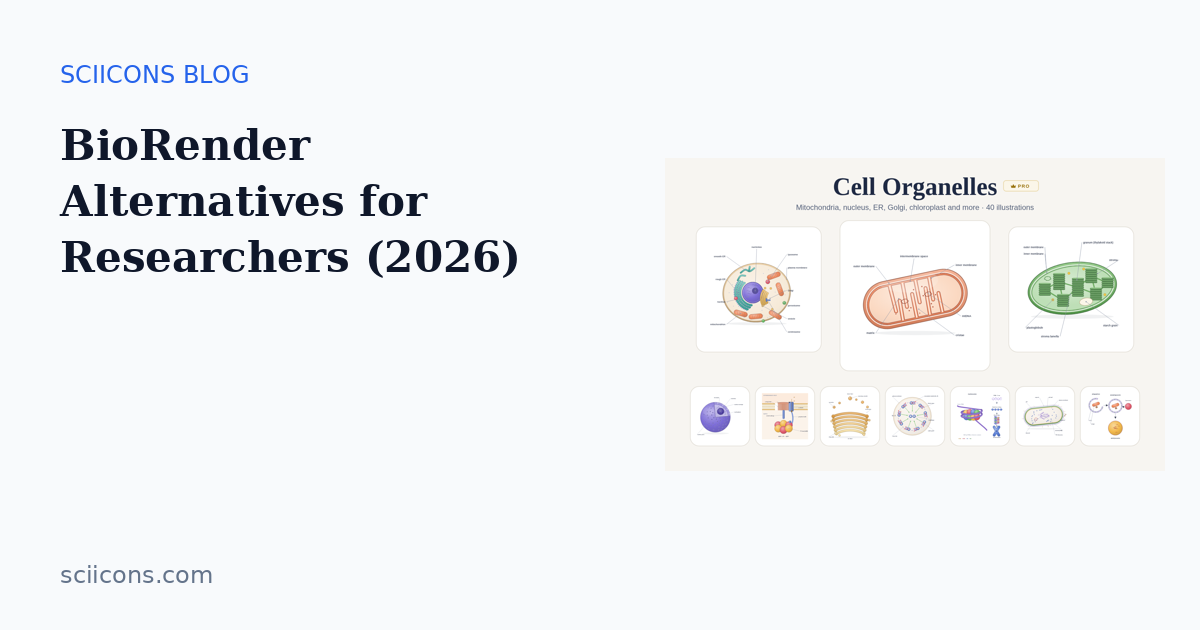
Sciicons is a free, searchable library of about 4,900 scientific SVG icons and illustrations (cells, microbiology, anatomy, chemistry, lab equipment and more). Each icon page shows its licence and credit line, icons can be copied as SVG or recoloured in the browser, and optional Pro packs add detailed original sets such as Cell Organelles and Assays. Sciicons also includes browser tools: Molecules (2D/3D structures from PubChem), Proteins (PDB ribbons and surfaces), the Gel Builder and the Well Plate Colorer; previews are free and their SVG/PNG downloads are part of Pro.
LabCanvas
LabCanvas is a browser-based scientific design platform with a 2D canvas, scientific icon packs, 3D generators, a protein visualizer, a molecule editor, an optics table and a chart editor, exporting SVG and PNG. You can get started free. The separate LabCanvas Blender addon (one-time purchase, Blender 4.2+) adds generators for molecules, crystals, DNA, neurons, membranes and devices for rendered 3D figures.
MolDraw
MolDraw is a free online chemical drawing tool with a 2D editor, reaction drawer, SMILES input, 3D viewer and image export, useful for the chemistry panels of a figure.
Why do researchers look for alternatives?
BioRender is popular, but three points drive people to look elsewhere:
- No publication rights on the free plan. BioRender's pricing page states that figures made on the free plan cannot be used for publications or commercial use (BioRender pricing).
- Watermarks on free exports. BioRender's licensing article says the watermark must remain on exports from Basic or Free Trial accounts (licensing help).
- Cost for individuals. The Academic Individual plan is listed at $39/month or $420/year (BioRender help); the Academic Lab plan is $129/month or $1,188/year for five seats (Lab plan). Student discounts exist with an academic email (pricing FAQ).
How do BioRender alternatives compare? Comparison table
| Option | Type | Free option | Publication on free option | Paid entry (as listed) | Output | Notes |
|---|---|---|---|---|---|---|
| BioRender | Online illustrator | Basic plan | No | $39/mo or $420/yr (Academic Individual) | PNG/PDF etc.; high-res on paid | Large catalogue, templates, collaboration |
| Mind the Graph | Online illustrator | Starter plan, no time limit | Watermark must stay; cite platform | Not shown on the pricing page when checked (unverified: third-party sites report ~$15/mo for Researcher) | Online editor exports | Says 75,000+ illustrations and 300 templates (pricing) |
| Servier Medical Art | Image library | Fully free | Yes, CC BY 4.0 with credit | n/a | Images, PowerPoint kits | Medical and biological drawings |
| NIH BioArt | Image library | Fully free | Yes; public domain or CC BY per item | n/a | Many vector files | Government-produced biomedical art |
| Bioicons | Icon library | Fully free | Per-icon license (CC0, MIT, CC BY, CC BY-SA, BSD) | n/a | SVG | Community-contributed, open source |
| SciDraw | Drawing library | Fully free | Yes, CC BY 4.0 or CC0 | n/a | SVG and others | Strong for neuroscience and animal models |
| Sciicons | SVG icon/illustration library | Free library | Yes; license shown per icon | Optional Pro packs (one-time Pro purchase) | SVG (copy or download) | ~4,900 icons; in-browser recolor |
| Inkscape | Vector editor | Free, open source (GPL) | Yes (your work) | n/a | SVG, PDF, EPS | Layout and editing |
| Affinity (by Canva) | Vector/pixel/layout editor | Free with Canva account | Yes (your work) | Some AI features need paid Canva | Vector and raster | macOS and Windows |
What does each alternative offer?
Mind the Graph
Mind the Graph (by Editage) is the closest in concept to BioRender: a browser-based editor with ready-made scientific illustrations and templates. Its pricing page describes 75,000+ editable illustrations and 300 templates (pricing page). The free Starter plan has no time limit, but every export must keep the Mind the Graph watermark, and the platform must be cited when used for formal work (free-use FAQ). The pricing FAQ confirms paid users can use figures in graphical abstracts and papers.
Uncertain: we could not read exact prices on the official pricing page on the date of checking; third-party reviews list about $15/month or $99/year for an individual Researcher plan. Confirm before purchasing.
Servier Medical Art (SMART)
Servier's SMART library provides medical and biological drawings that you may share and adapt, including commercially, under CC BY 4.0. You must credit Servier, link to the license and indicate if changes were made (terms of use). Servier publishes a recommended citation format (how to cite).
Best for: anatomy, organs, cells and clinical scenes in a consistent hand-drawn style.
NIH BioArt Source
NIAID's BioArt offers biomedical illustrations, many as vector files. Assets labelled Public Domain can be used without citation; assets labelled CC BY need attribution (FAQs, terms).
Best for: lab equipment, pathogens, cells and infectious-disease topics.
Bioicons
Bioicons is an open-source library of science icons maintained on GitHub. Licenses vary per icon (CC0, MIT, CC BY, CC BY-SA, BSD), so check each one.
SciDraw
SciDraw hosts free drawings of animals, neurons and experimental setups. Drawings are licensed CC BY 4.0 (credit the creator) or CC0 (licensing).
Sciicons
Sciicons is a free library of scientific SVG icons and illustrations, roughly 4,900 at the time of writing. It combines open collections (for example NIH BioArt, Servier, Health Icons and PhyloPic) with original drawings, all searchable in one place by category such as cells, microbiology, anatomy or lab equipment. Every icon page shows its license and the credit line to use, icons can be copied as SVG straight into slides or a vector editor, and colors can be changed in the browser. Optional Pro packs add detailed original sets, such as cell organelles, assays and cardiovascular illustrations.
Free vector editors: Inkscape and Affinity
An icon library alone does not make a figure; you need somewhere to assemble it. Inkscape is free and open source under the GPL (license). Affinity became free for everyone in 2025 and needs a free Canva account (Canva Help). Both export vector PDF and SVG suitable for journals.
How should you choose an alternative?
If you need speed and templates
Choose an online illustrator (BioRender or Mind the Graph) on a paid plan if the figure is going into a publication. Check that the plan's license covers your use (journal, cover image, commercial).
If you need zero cost and full rights
Use Inkscape or Affinity with CC0 or public-domain assets first, then CC BY assets with credits. Keep a simple credits list as you build the figure.
If you need a consistent visual style
Mixing libraries can look patchy. Pick one primary library for a figure and harmonize colors (most SVG icons can be recolored in a vector editor; Sciicons also offers recoloring in the browser).
How do you migrate an existing BioRender figure?
If you made a figure on BioRender's free plan and now want to publish it, you have two honest options:
- Upgrade and export under a paid plan to obtain a publication license. BioRender notes that figures exported while on a paid plan keep their publishing rights after you downgrade (publication license guide).
- Rebuild the figure with openly licensed assets in a vector editor. Do not trace or reuse BioRender icons outside its license.
Sources
- BioRender pricing: https://www.biorender.com/pricing
- BioRender Academic Individual: https://help.biorender.com/hc/en-gb/articles/17605400045085-The-Academic-Individual-Subscription
- BioRender Academic Lab: https://help.biorender.com/hc/en-gb/articles/17605417010845-The-Academic-Lab-Subscription
- BioRender licensing: https://help.biorender.com/hc/en-gb/articles/17605388551197-Licensing-and-usage-of-figures-made-in-BioRender
- Mind the Graph pricing: https://mindthegraph.com/pricing
- Mind the Graph free use: https://mindthegraph.com/blog/faq/use-mind-the-graph-for-free/
- Servier Medical Art terms: https://smart.servier.com/terms-of-use/
- NIH BioArt terms: https://bioart.niaid.nih.gov/terms
- Bioicons: https://github.com/duerrsimon/bioicons
- SciDraw licensing: https://scidraw.io/licensing
- Inkscape license: https://www.inkscape.org/about/license/
- Affinity free access: https://www.canva.com/help/free-affinity-access/
Frequently asked questions
- Is there a free alternative to BioRender?
- Yes. Combining a free vector editor (Inkscape or Affinity) with openly licensed libraries such as Servier Medical Art (CC BY 4.0), NIH BioArt (public domain or CC BY per item), Bioicons, SciDraw or Sciicons gives you publishable figures at no cost, as long as you follow each asset's license.
- Can I publish figures from BioRender's free plan?
- No. BioRender's pricing page says figures made on the free plan cannot be used for publication or commercial use. Publication rights come with paid plans such as Academic Individual ($39/month or $420/year as listed in BioRender's help center).
- Is Mind the Graph free?
- Mind the Graph has a free Starter plan with no time limit, but exports keep a watermark and you must cite the platform. Paid plans remove the watermark; check the official pricing page for current prices, which vary by plan and billing period.
- Which BioRender alternative is best for a graphical abstract?
- If you want templates and a drag-and-drop editor, Mind the Graph is the closest equivalent. If you prefer full control and no subscription, use Inkscape or Affinity with CC0 or CC BY icons from Sciicons, Bioicons, Servier or NIH BioArt.
- Do I need to credit icons from free libraries?
- It depends on the license. CC0 and public-domain assets need no credit (though it is good practice); CC BY assets, such as Servier Medical Art, require attribution, usually in the figure legend or acknowledgments.
More guides on the Sciicons blog · Browse scientific illustrations · Free figure tools