Free Protein Structure Viewers and AlphaFold Tools
Free protein viewers and AlphaFold tools compared: Sciicons Proteins, Mol*, ChimeraX, PyMOL, AlphaFold DB, AlphaFold Server, ColabFold and ESMFold.
Last updated: October 11, 2026. Licences, limits and database sizes were checked on the official sites under Sources on that date.
Quick answer: The best free protein structure tools in 2026 are Mol* for browser viewing, UCSF ChimeraX and open-source PyMOL for desktop analysis and rendering, Sciicons Proteins for quick figure graphics, AlphaFold DB for 200+ million precomputed predictions, and AlphaFold Server or ColabFold for predicting new structures from your own sequences.
What is a protein structure viewer?
A protein structure viewer is software that reads 3D coordinate files (PDB or mmCIF) and displays the molecule as cartoons, surfaces or atoms so you can inspect folds, binding sites and interactions, and export images. Structure prediction tools such as AlphaFold are different: they generate those coordinates from an amino-acid sequence.
Which free protein viewers are best? Comparison table
| Tool | Licence / cost | Runs in | Best for |
|---|---|---|---|
| Sciicons Proteins | Free preview; SVG/PNG download with Pro | Browser | Ribbon, surface and ball-and-stick graphics from PDB entries for figures |
| LabCanvas | Free plan; Blender addon is a one-time purchase | Browser / Blender | Protein visuals in a figure editor; rendered 3D art in Blender |
| Mol* | Open source (MIT) | Browser | Fast viewing of large structures; used by RCSB PDB and AlphaFold DB |
| UCSF ChimeraX | Free for academic, non-profit and government research | Windows, macOS, Linux | Analysis, cryo-EM maps, high-quality rendering |
| PyMOL (open source) | Open source (BSD-like); Incentive PyMOL is paid | Windows, macOS, Linux | Scripted figures, classic publication images |
| iCn3D (NCBI) | Free | Browser | Sharing annotated views by URL |
What do Sciicons Proteins and LabCanvas offer?
Sciicons Proteins
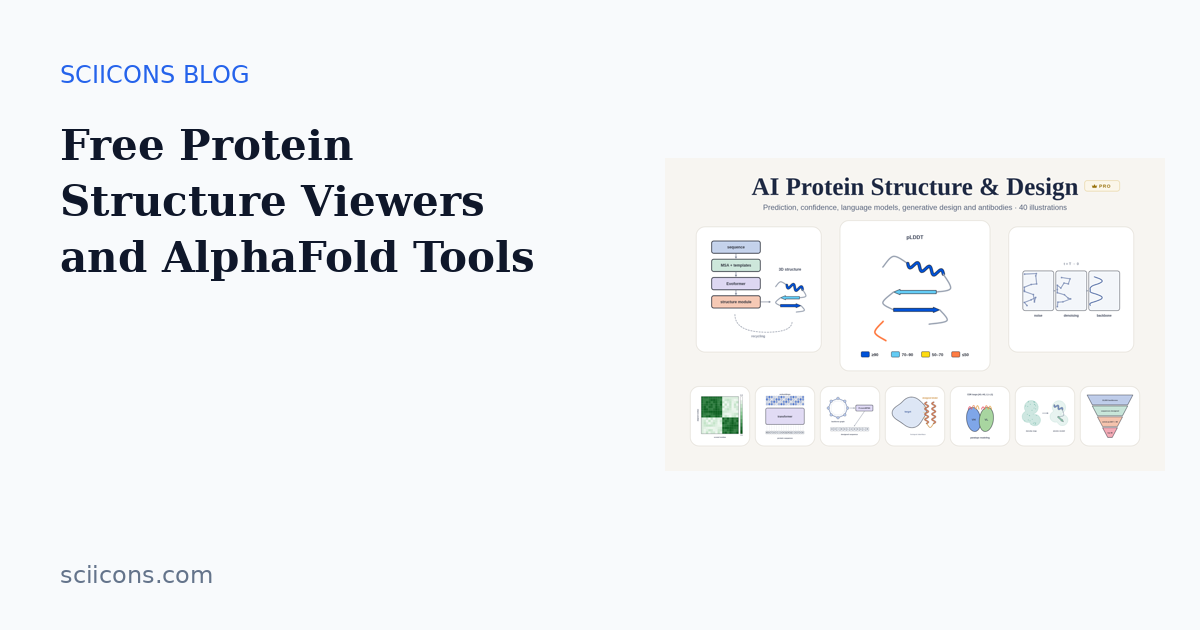
Sciicons Proteins loads a structure by PDB ID or protein name from RCSB PDB and renders it in three styles: ribbon, surface and ball-and-stick. You can preview and adjust it for free; SVG and PNG downloads are included with Sciicons Pro. It is built for clean figure graphics that match Sciicons illustrations such as the AI Protein Structure & Design pack, not for structural analysis.
LabCanvas
LabCanvas is a browser-based scientific design platform whose workspace includes a protein visualizer alongside a 2D editor, molecule editor and chart editor. The separate LabCanvas Blender addon imports PDB files into Blender for rendered 3D scenes, which is useful for journal covers and posters.
Which viewer should you use for analysis?
Mol*
Mol* is an open-source (MIT) web toolkit that powers the 3D views on RCSB PDB and AlphaFold DB. It handles very large assemblies in the browser and can colour AlphaFold models by confidence.
UCSF ChimeraX
ChimeraX is free for academic, non-profit and government-sponsored research; commercial use needs a separate licence. It is strong for cryo-EM density maps, measurements and ray-traced figure rendering, and it can fetch AlphaFold models directly.
PyMOL
PyMOL exists as an open-source build (BSD-like licence) and as Schrödinger's paid Incentive PyMOL, which adds support and precompiled installers. Its command language makes figures reproducible.
iCn3D
iCn3D from NCBI is a free web viewer whose custom views can be shared as a URL, which is handy for teaching and reviewers.
Which AlphaFold and structure-prediction tools are free?
| Tool | What it does | Cost and limits |
|---|---|---|
| AlphaFold DB (EMBL-EBI and Google DeepMind) | Precomputed predicted structures | Free, CC BY 4.0; over 200 million predictions |
| AlphaFold Server | Runs AlphaFold 3 on your sequences, incl. DNA, RNA, ligands, ions | Free for non-commercial use; 30 jobs per day per user |
| ColabFold | Open-source AlphaFold2/RoseTTAFold pipeline with fast MMseqs2 MSAs | Free code; runs on Google Colab or local GPU |
| ESMFold / ESM Metagenomic Atlas | Single-sequence prediction from a protein language model | Free; the Atlas holds about 617 million predicted metagenomic structures (Lin et al., 2023) |
| RCSB PDB | Experimentally determined structures | Free; more than 200,000 entries |
AlphaFold DB
AlphaFold DB provides over 200 million predictions covering most of UniProt, free for academic and commercial use under CC BY 4.0. Search by gene name or UniProt accession and download PDB or mmCIF files.
AlphaFold Server
AlphaFold Server runs AlphaFold 3 for complexes of proteins with DNA, RNA, ligands, ions and modifications. According to the EMBL-EBI training course and the server's terms, it is free for non-commercial use and capped at 30 jobs per user per day.
ColabFold and ESMFold
ColabFold (Mirdita et al., Nature Methods 2022) makes AlphaFold2 predictions accessible in a notebook. ESMFold predicts structure from a single sequence, which is faster but usually less accurate than MSA-based AlphaFold for many proteins.
How do you read AlphaFold confidence scores?
- pLDDT (per-residue confidence, 0–100): above 90 is very high, 70–90 is confident, 50–70 is low and below 50 is very low, according to AlphaFold DB documentation. Very low regions are often intrinsically disordered.
- PAE (predicted aligned error): a heatmap of expected position error between residue pairs. Low PAE between two domains means their relative orientation is reliable.
- Rule of thumb: colour figures by pLDDT and show the PAE plot in supplementary material whenever you interpret a predicted model.
How do you make a protein figure step by step?
- Find the structure. Search RCSB PDB for an experimental structure first; fall back to AlphaFold DB for predictions.
- Choose the representation. Cartoon/ribbon for folds, surface for binding pockets and shape, sticks for ligands and key residues.
- Colour with purpose. Use chains, domains or pLDDT; keep palettes colour-blind safe.
- Render and export. Export SVG or a high-resolution PNG (300 dpi or more at final size), or ray-trace in ChimeraX/PyMOL.
- Annotate in a layout tool. Add labels, ligands and schematic context with Sciicons protein illustrations.
- Cite. Give the PDB ID or AlphaFold DB accession and the software used in the legend or methods.
Sources
- AlphaFold DB and FAQ: https://alphafold.ebi.ac.uk/ , https://alphafold.ebi.ac.uk/faq
- AlphaFold Server (EMBL-EBI course): https://www.ebi.ac.uk/training/online/courses/alphafold/alphafold-3-and-alphafold-server/alphafold-server-your-gateway-to-alphafold-3/
- AlphaFold Server terms: https://www.gstatic.com/alphafoldserver/app/app/routes/terms_text/AlphaFold-Server-Additional-Terms-of-Service.pdf
- UCSF ChimeraX licensing: https://www.cgl.ucsf.edu/chimerax/docs/licensing.html
- PyMOL open source: https://github.com/schrodinger/pymol-open-source
- Mol* (RCSB): https://github.com/molstar/rcsb-molstar
- ColabFold: Mirdita et al., Nature Methods 19, 679–682 (2022), https://github.com/sokrypton/ColabFold
- ESM Metagenomic Atlas: Lin et al., Science 379, 1123–1130 (2023)
- iCn3D: https://www.ncbi.nlm.nih.gov/Structure/icn3d/
- LabCanvas: https://labcanvas.com/ and https://blender.labcanvas.com/ (checked 11 Oct 2026)
Frequently asked questions
- What is the best free protein structure viewer?
- For browser viewing, Mol* (used by RCSB PDB and AlphaFold DB) is free and open source under the MIT licence. For desktop analysis and figure rendering, UCSF ChimeraX is free for academic and non-commercial use, and open-source PyMOL is free to build and use. For quick figure graphics, Sciicons Proteins renders PDB entries as ribbons or surfaces in the browser.
- Is AlphaFold free to use?
- Yes, with conditions. AlphaFold DB predictions are free under CC BY 4.0, including commercial use. AlphaFold Server, which runs AlphaFold 3, is free for non-commercial use and limits each user to a daily number of jobs (30 per day at the time of writing).
- What is the difference between AlphaFold DB and AlphaFold Server?
- AlphaFold DB is a database of precomputed predictions you can look up by UniProt accession. AlphaFold Server is a web service that runs new AlphaFold 3 predictions for your own sequences, including complexes with DNA, RNA, ligands and ions.
- How do I judge whether an AlphaFold model is reliable?
- Look at the per-residue pLDDT score (above 90 is very high confidence, below 50 is very low) and the PAE plot, which shows confidence in the relative position of domains. Low-confidence regions are often disordered and should not be interpreted as fixed structure.
- Can I use protein images from these viewers in a paper?
- Generally yes. Cite the PDB entry or AlphaFold DB model and the software you used; AlphaFold DB requires attribution under CC BY 4.0. Check each tool's citation request in its documentation.
More guides on the Sciicons blog · Browse scientific illustrations · Free figure tools